Why Do So Many African Flags Share the Same Colours?
23 Aug 20265 min read
Describing a flag out loud is harder than it looks, unless you know the words for it. Flag experts use a precise vocabulary, most of it borrowed from medieval heraldry. Here is the essential toolkit, one term at a time.
Try to describe the flag of the United States precisely enough that someone could draw it without seeing it. Most people reach for phrases like the top left corner and the stripey part, which works, but only just. People who study flags do not talk that way. They use a sharp vocabulary that can fix any banner in a single sentence, so that a vexillologist in Tokyo and a vexillologist in Lima will understand each other without a picture.
The study of flags is called vexillology, from the Latin word vexillum, which was a small square banner carried by Roman cavalry, joined to the Greek ending meaning the study of. The word is recent even though flags are ancient. It was coined in 1957 by the American scholar Whitney Smith, who is generally regarded as the founder of the modern field. A person who studies flags is a vexillologist, and a person who designs them is a vexillographer. What follows is a glossary of the terms worth knowing, each with its own diagram.
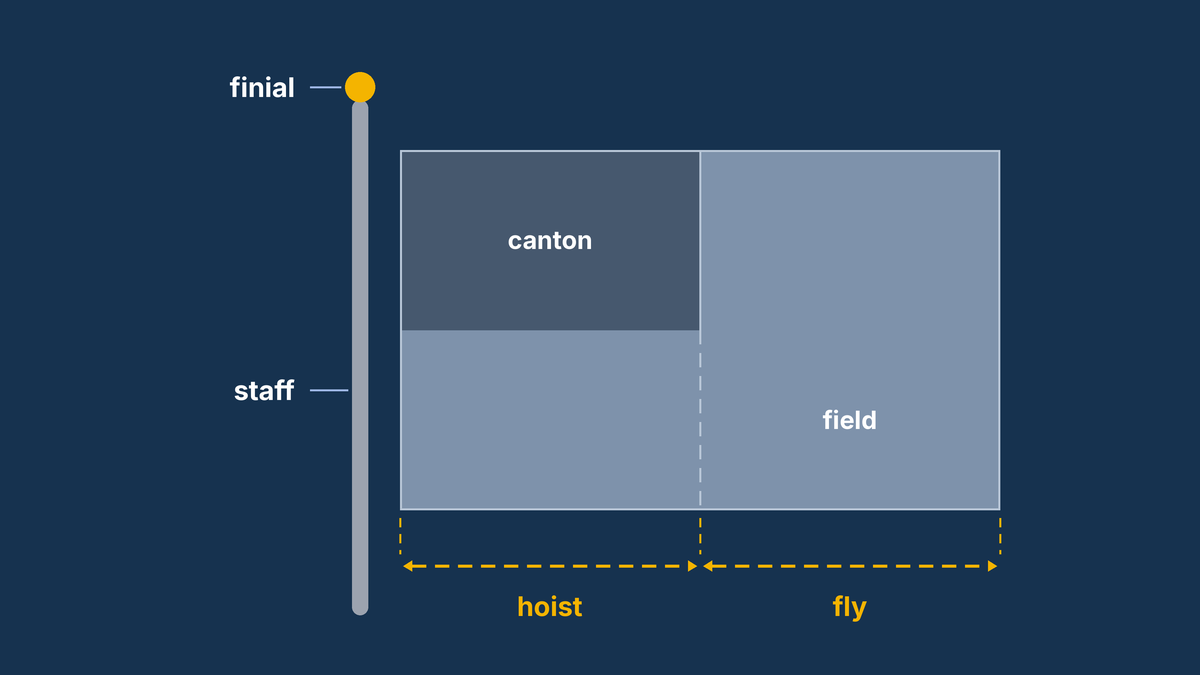
The finial is the ornament at the very top of a flagpole, often a ball or a spearhead. It is not part of the cloth itself, but it belongs to the way a flag is mounted and displayed, and it is the first thing the eye meets above the flag.
Example: In the United States, ceremonial flagpoles are often crowned with a gold eagle finial.

The flagstaff is the pole that the flag is attached to and raised on. The side of the flag next to it is the hoist, which is where the terms for the cloth itself begin.
Example: One of the world's tallest flagstaffs raises the flag of Saudi Arabia in Jeddah.

The hoist is the half of the flag nearest the pole, and the word also names the vertical edge attached to it. It doubles as a measurement, since the hoist is a flag's height. This side matters most, because it stays visible even when there is no wind and the flag hangs limp.
Example: On the flag of Benin, a green band fills the entire hoist.

The fly is the opposite half, the free edge that moves in the wind, away from the pole. Like the hoist, it also names a dimension, since the fly is a flag's width or length. Something placed at the fly sits on the outer end.
Example: On the flag of Fiji, the shield sits out in the fly, away from the pole.

The field, sometimes called the ground, is the background of the flag, the base colour or colours on which everything else rests. When we say that Japan has a white field, we mean that the whole background is white before the red disc is added.
Example: From 1977 to 2011, the flag of Libya was a plain green field with nothing on it at all.

The canton is the upper corner on the hoist side, and it is the most prestigious spot on any flag. The stars of the United States sit in the canton, and so does the Union Jack on the flags of Australia and New Zealand. When a flag wants to say who it belongs to or what it honours most, it usually says so here.
Example: The flag of Chile carries a single white star in a blue canton.

The chief is the upper part of the flag, the horizontal strip along the top edge. It names a position rather than a shape: a charge placed in chief sits high on the field.
Example: On the flag of Poland, white occupies the chief and red the base.

The base is the lower part of the flag, the strip along the bottom edge, opposite the chief. A charge placed in base sits low on the field.
Example: On the flag of Poland, red occupies the base and white the chief.

A charge is any emblem placed on the field, such as a star, an eagle, a cross, or a coat of arms. A flag of plain stripes is uncharged, and adding a symbol makes it charged. The sun and moon of Nepal are charges, and so is the maple leaf of Canada.
Example: The eagle devouring a serpent on the flag of Mexico is a charge.

Defacement sounds harsher than it is. In vexillology it simply means adding a charge to an existing flag in order to create a variant. Many national ensigns are defaced versions of a plainer flag with a badge added on top.
Example: The flag of Australia is a defaced British Blue Ensign, with the Commonwealth star and Southern Cross added.

A pale is a vertical band running down the centre of the flag. It comes straight from heraldry, like most of the terms for how a flag is divided.
Example: The French tricolour is formed of three pales : blue, white, red.

A fess is a horizontal band across the middle of the flag.
Example: Austria's flag is made of three fesses: red, white, red.

A bend is a diagonal band running from one corner of the flag to the other.
Example: A red bend crosses the flag of the DR Congo diagonally, from hoist to fly.

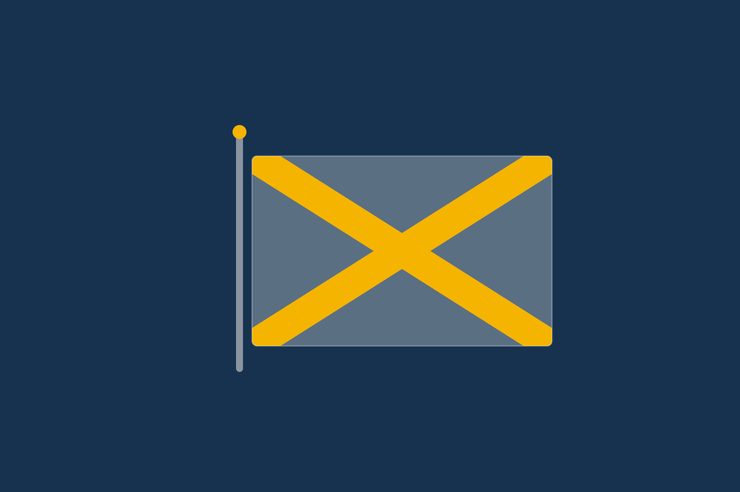
A saltire is a diagonal cross in the shape of an X. The flags of Scotland and Jamaica are both built on a saltire.
Example: Jamaica bears a gold saltire dividing the flag into four triangles — two green (in chief and base) and two black (at the hoist and fly).
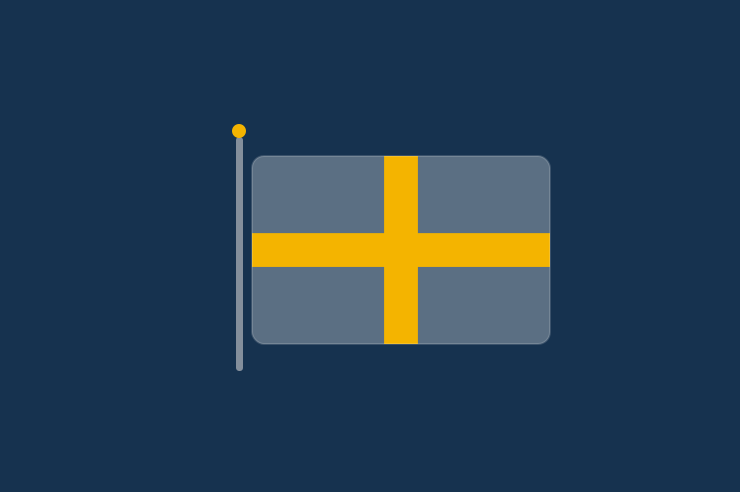
A cross is an upright cross, one arm running vertically and one horizontally. When it is shifted toward the hoist rather than centred, it becomes the Nordic cross shared by the Scandinavian flags.
Example: Switzerland and Greece both carry a cross; Denmark's Dannebrog is a Nordic cross shifted toward the hoist.
A chevron is a V-shaped band, its point turned toward the fly. As a plain stripe it is uncommon on national flags, but the wedge it describes reappears whenever a triangle is set against the hoist.
Example: The wedge that Cuba and the Czech Republic drive in from the hoist is a triangle, the chevron's solid cousin.

A pall is a Y-shaped band, its two arms reaching into the hoist corners and its stem running to the fly.
Example: South Africa's flag is built on a green pall whose arms reach the two hoist corners and whose stem runs to the fly.

A triangle is most often set against the hoist, its base on the pole edge and its point aimed at the fly. It is one of the most common ways to break up a field of stripes.
Example: Cuba, the Czech Republic, Sudan and the Philippines all drive a triangle in from the hoist.

A bordure is a border that runs all the way around the edge of the field. Once these few words are in place, you can describe almost any geometric flag in a single breath. Three parallel stripes make a triband, two colours make a bicolour, and three colours make a tricolour.
Example: A golden bordure frames the entire flag of Sri Lanka.

A swallowtail is a flag with a V shaped notch cut into the fly, leaving two tapering points. Several Nordic countries, including Denmark, Norway, and Iceland, use a swallowtail for their official state flags while their everyday civil flag stays a plain rectangle.
Example: Denmark's official state flag, the Splitflag, is a swallowtail, while ordinary Danes fly a plain rectangle.

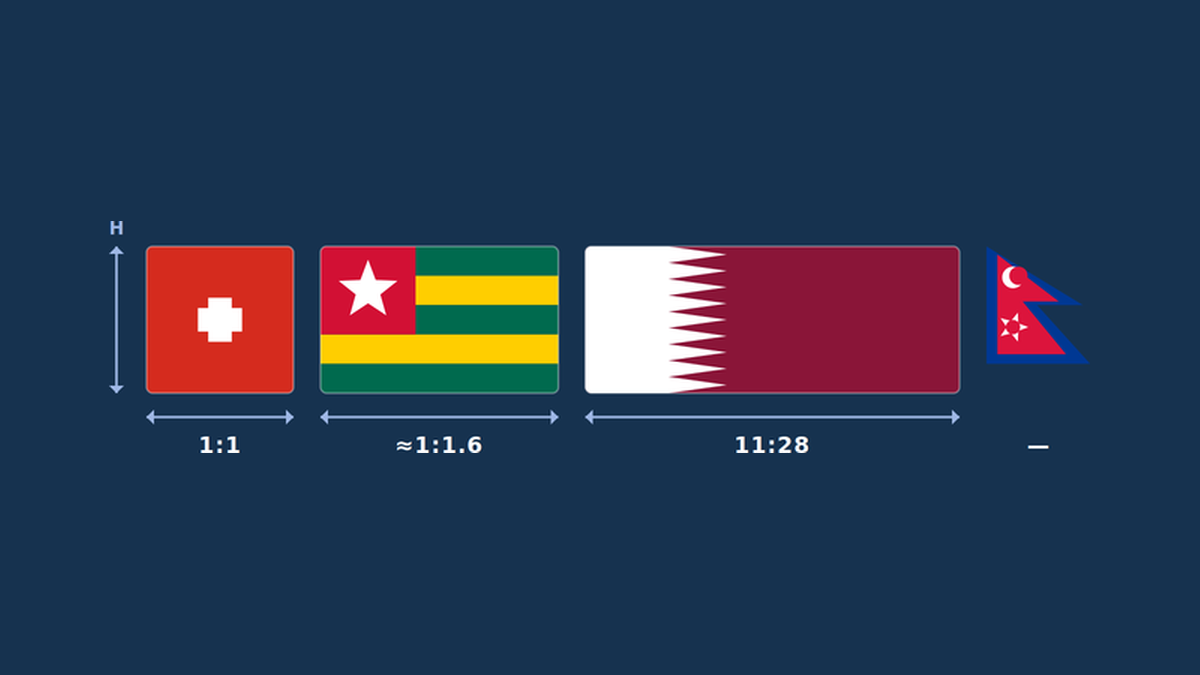
A pennant, sometimes spelled pennon, is a long tapering flag, often triangular. The national flag of Nepal is essentially two pennants stacked one above the other, which is why it is the only national flag in the world that is not a rectangle.
Example: Nepal is the only country whose national flag is built from pennants : two of them, one above the other.

Not every flag is a national flag, and some carry specific duties. An ensign is a flag flown to show nationality, especially at sea on ships. A jack is a small flag flown at the bow, the front of a ship, separate from the ensign flown at the stern. Many countries also keep two versions of their flag. A plain civil flag is for ordinary citizens, while a state flag, often with a coat of arms added, is reserved for government use. This is why the flag on a government building can look subtly different from the one on an emoji.
Once these words are in place, something changes. Instead of the blue corner with the stars and the stripey part, you can say a field of thirteen red and white stripes with a blue canton charged with fifty white stars, and any vexillologist on Earth will know exactly which flag you mean. That precision is the point. Flags are a global language, spoken by every nation and understood almost everywhere, and vexillology is simply its grammar.
Keep exploring