
Why Do So Many African Flags Share the Same Colours?
23 Aug 20265 min read
Purple was the colour of emperors, and it is almost entirely absent from the world's flags. The explanation involves a Mediterranean sea snail, an eye-watering price, and spectacularly bad timing.
Run through the flags of the world and you will find red almost everywhere, blue nearly as often, green and yellow in abundance, black and white throughout. Then you will look for purple and find essentially nothing.
This is odd. Purple has been associated with sovereignty, imperial authority and prestige for over three thousand years, which is precisely what national flags usually try to project. It should be everywhere. It is nowhere.
The explanation is one of the most satisfying stories in vexillology, because it has almost nothing to do with symbolism and almost everything to do with snails.
The purple in question is Tyrian purple, produced by the Phoenicians in the city of Tyre, in present-day Lebanon. The word "purple" itself comes from the Greek porphura, a reference to the purpura mollusc.
The dye was extracted from the hypobranchial gland of Murex sea snails, and the yield was catastrophic. The most widely cited estimate, from the historian David Jacoby, is that around 12,000 snails produce roughly 1.4 grams of pure dye, enough to colour the trim of a single garment. Each snail had to be collected, cracked and processed by hand, and the snails were concentrated in a limited stretch of the Mediterranean. The process reportedly stank so badly that dyeworks were pushed to the edges of cities.
The price followed. Diocletian's Edict on Maximum Prices, issued in 301 CE, valued one pound of murex-dyed wool at 150,000 denarii, which was worth roughly three pounds of gold. Roman sumptuary law restricted the colour by rank: only the emperor could wear a full Tyrian purple cloak, while senators were limited to a purple stripe on the toga. That was not a metaphor about prestige but a legal restriction on who was permitted to wear it.
For a flag, this was disqualifying. A flag is not a ceremonial robe worn once. It is a mass-produced object that has to be reissued constantly as it wears out, and replicated across ships, garrisons, embassies and public buildings. No treasury on earth was going to fund that in Tyrian purple.
The economics changed abruptly in 1856, when the eighteen-year-old British chemist William Henry Perkin, attempting to synthesise quinine, accidentally produced the first commercial synthetic dye. He called it mauveine. Purple became cheap, fast, and available to anyone.
By then it was too late.
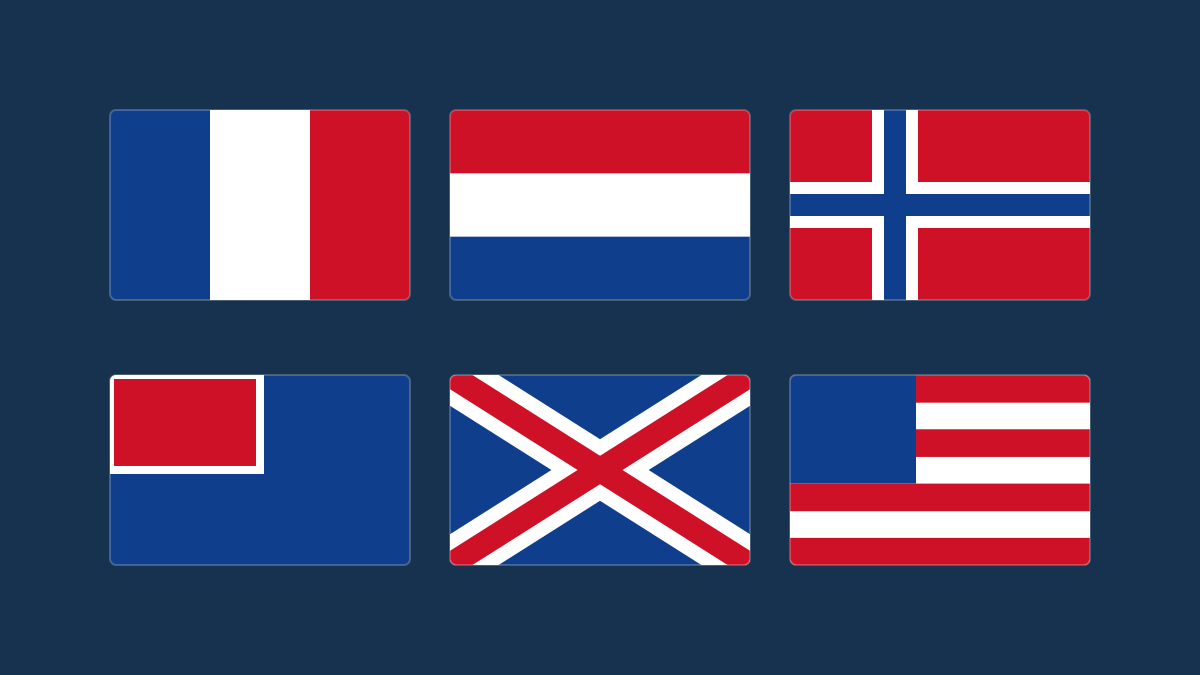
The great age of national flag creation was already well advanced. The French tricolour dated from 1794, the Stars and Stripes from 1777. The Danish Dannebrog is traditionally dated to 1219. The Dutch, British, Russian, Spanish, Swedish and Portuguese designs were all long established. By the time purple became practical, the world's visual identities had largely been assigned, and there was no reason to reopen them.
Purple did not lose on merit. It missed the deadline.
Here the story gets more interesting than the version usually repeated online.
The popular claim is that exactly two national flags contain purple: Dominica and Nicaragua.
Dominica is the clearest case. Its flag, designed by playwright Alwin Bully and adopted on 3 November 1978, carries a Sisserou parrot at its centre, the imperial amazon Amazona imperialis, with purple plumage on the crown and underside. The bird is endemic to Dominica's mountain forests and listed as critically endangered. Its numbers have collapsed: from an estimated 160 to 240 mature individuals in 2012 to roughly 50 in the 2019 assessment, after Hurricane Maria devastated the island's forests in 2017. Dominica is the one country that put purple deliberately and prominently at the heart of its design.
Nicaragua is a technicality. Its coat of arms contains a small rainbow arcing over five volcanoes, and that rainbow includes a purple band. You need to look closely.
But if that counts, so does El Salvador, whose coat of arms features the same volcano-and-rainbow motif, adopted in 1912. And Bolivia's co-official Wiphala, the chequered Andean flag recognised alongside the national tricolour since 2009, contains purple squares outright.
Spain belongs on the list too, in a way that is easy to miss. Its coat of arms includes the arms of the old Kingdom of León, whose lion is traditionally blazoned in purpure, the heraldic word for purple, a colour that goes back to the medieval standard of León. It is rarely counted, because the lion is a small detail often printed in a reddish tone rather than a clear purple. Spain also once flew an unmistakably purple flag: from 1931 to 1939 the Second Republic used a red, yellow and purple tricolour, still raised by republicans today although it has no official standing.
The honest answer is that one flag uses purple as a genuine design element, and between two and four contain it depending on how you count rainbows and co-official flags. The tidy "only two" you will read everywhere is a simplification that quietly excludes Bolivia, El Salvador and Spain.
The absence of purple demonstrates something easy to forget about flags: they are physical manufactured objects before they are symbols.
The same logic explains a great deal else. Flags favour high-contrast colours because they must be legible from a distance, in motion, against the sky. They avoid fine detail and lettering because both vanish at range and reverse on the back. They repeat a small set of colours because those were the dyes that were stable, affordable and lightfast.
Every national flag is a negotiation between what a country wanted to say and what its dyers, weavers and treasury could actually deliver. Purple lost that negotiation for roughly three thousand years, and by the time it finally won, nobody was still asking the question. To explore more: https://en.wikipedia.org/wiki/List_of_flags_containing_the_color_purple
Keep exploring