Why Do So Many African Flags Share the Same Colours?
23 Aug 20265 min read
France, the United States, the United Kingdom, Russia, Thailand, Chile, Australia, Cuba, Norway, the Netherlands. The same three colours, over and over. Not a coincidence, but three separate histories that happened to collide.
Line up the flags of the world and one palette dominates so heavily it starts to look like a conspiracy. Red, white and blue turns up on every continent, across every political system, in monarchies and republics, in countries that have nothing else in common.
No committee arranged this. Three separate stories each spread the same three colours across a different part of the map, and they overlap just enough to make the pattern look universal.
The most influential flag design in history was assembled in Paris in 1789 out of a cockade.
The blue and red were the colours of Paris, worn on the badges of the city's militia. The white belonged to the Bourbon monarchy. Lafayette is credited with combining them into a single cockade, placing the people's colours around the king's so that the monarch appeared symbolically surrounded by his citizens. The tricolour flag followed, and the vertical three-band format was formalised in 1794.
What mattered was not the colours themselves but what the design came to signify. The French tricolour became legible shorthand for revolution, republic, and the sovereignty of the people. Any nation founding itself on those ideas had a ready-made visual vocabulary, and dozens took it.
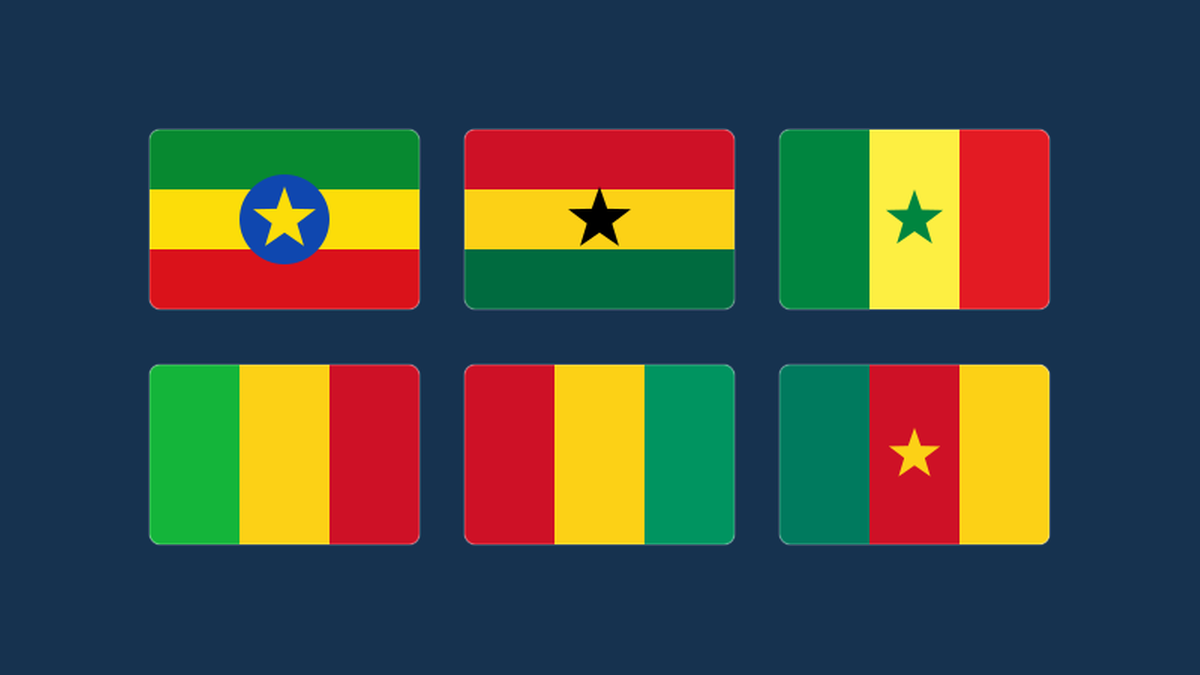
Look at the vertical tricolours of the world: Italy, Ireland, Belgium, Mexico, Romania, Chad, Mali, Guinea, Côte d'Ivoire, Nigeria, Peru. All of them descend from a design decision made in a French city in 1789. Most changed the colours. Almost none changed the structure.
The second thread has nothing to do with revolution and everything to do with shipping.
Britain's ensigns, the Red, White and Blue Ensigns used to distinguish squadrons of the Royal Navy and later merchant and civil vessels, carried the Union Jack in the canton on a red, white or blue field. As British maritime and colonial reach expanded, that template travelled with it. Territories were issued a Blue Ensign with a local badge in the fly.
This is why Australia, New Zealand, Fiji, Tuvalu and others still fly a dark blue field with the Union Jack in the corner. It is also, indirectly, why the United States flag looks the way it does. The thirteen colonies were British, and red, white and blue was simply the visual language they already spoke. The symbolism you often see quoted, white for purity, red for valour, blue for justice, was applied to the Great Seal in 1782, well after the fact. The colours came first. The meaning was attached later.
That is one of the most useful things to understand about flags in general. The symbolism printed on an official government page is frequently a retrofit, a story told about a design that was chosen for practical or inherited reasons.
The third thread runs east.
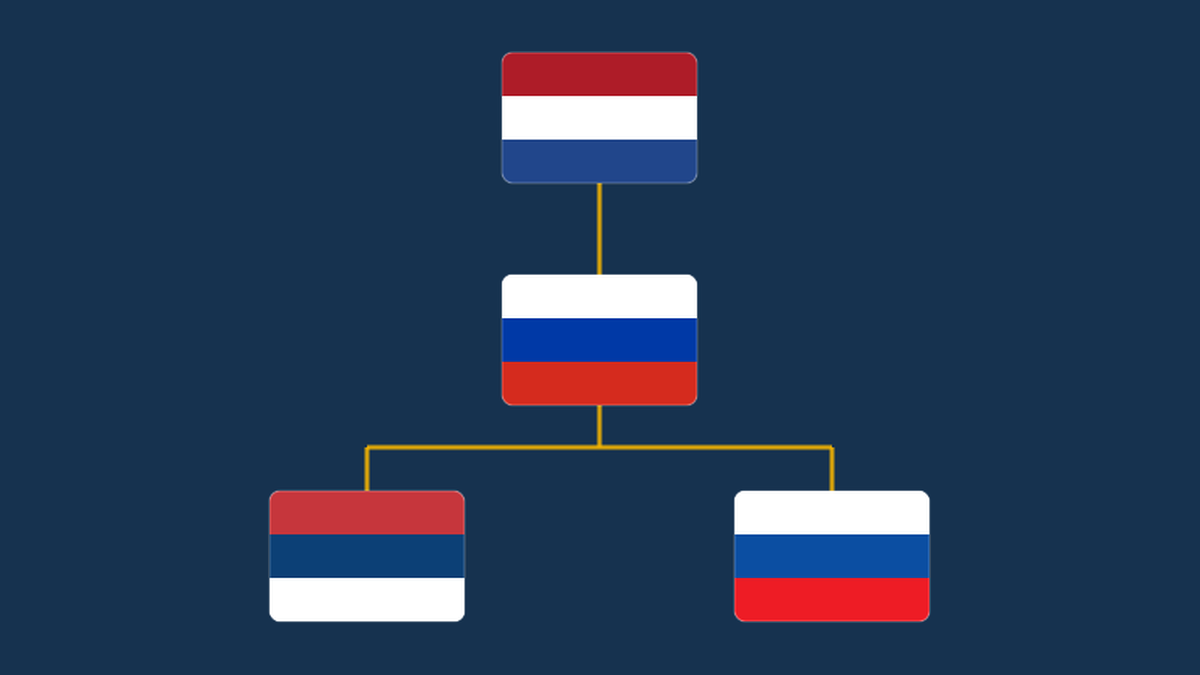
At the Prague Slavic Congress, held from 2 to 12 June 1848, delegates from Slavic nations across the Habsburg and Ottoman empires adopted white, blue and red as their shared colours, taken from the flag of Russia, then the only large independent Slavic state.
And where did the Russian flag get them? From the Netherlands. In 1693 Peter the Great ordered a frigate from Amsterdam; when it arrived the following year it flew the Dutch red, white and blue from its stern. Peter modelled a Russian ensign on it, reordering the colours, and introduced the design for merchant shipping in the 1690s.
This is worth pausing on, because it undercuts the symbolism you will usually read. The meanings attached to the Russian tricolour, white for purity or freedom, blue for the Virgin or for fidelity, red for sovereignty or courage, are later attributions, and several competing versions circulate. The colours were a maritime borrowing before they were a national symbol.
As Slavic nations gained independence over the following century, they built on the 1848 palette. Serbia, Croatia, Slovenia, Slovakia and the Czech lands all drew from it, and Bulgaria did too, swapping blue for green.
This is the direct reason Russia, Slovakia and Slovenia are so easy to confuse today. They are not imitating each other. They are all citing the same 1848 decision.
Underneath all three histories sits a practical constraint that gets far less attention than it deserves.
A flag has to work as a physical object. It has to be dyed in bulk, survive weather and sunlight, and stay identifiable from a distance, in motion, often against a bright sky. That narrows the field considerably.
Red and blue were among the most stable, available and affordable strong dyes in history. Madder and cochineal produced red, indigo and later Prussian blue produced blue. White required no dye at all. The three together happen to give excellent contrast, offering a dark, a light and a mid-tone that stay readable when the fabric is faded, wet or backlit.
Compare that with the near-total absence of purple, which stayed ruinously expensive until synthetic dyes arrived in the nineteenth century, by which point most national flags already existed.
Red, white and blue is not only an ideological inheritance. It is also a very good engineering answer to the problem of being seen.
Counts vary depending on whether you include territories and dependencies, but the figure that recurs across sources is around thirty national flags using all three colours, out of roughly 195. That is closer to one in seven than to the "one third" often repeated online.
Taken separately the individual colours are far more common. Guinness World Records puts red on about 74% of national flags, white on 71% and blue on 50%. What makes red, white and blue notable is not that it covers a third of the world, but that no other three-colour combination is used nearly as often.
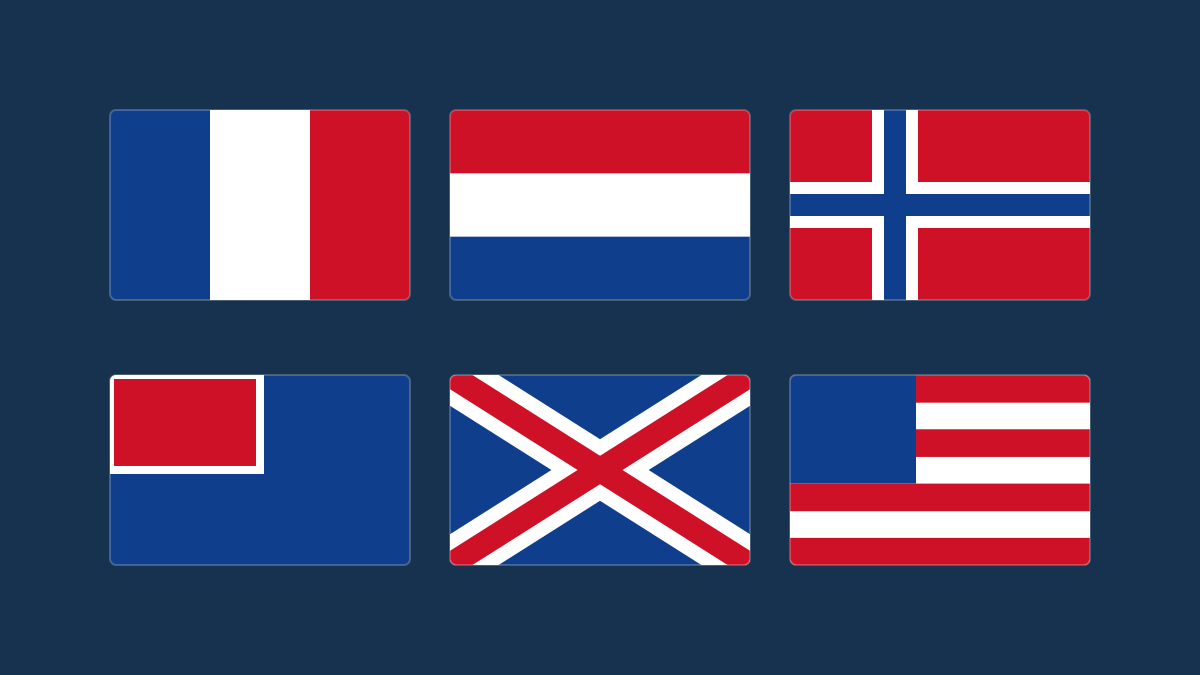
More revealing is how the three colours are used. The same trio produces the French vertical tricolour, the Dutch horizontal tricolour, the Nordic cross of Norway and Iceland, the overlapping saltires of the Union Jack, the stars and stripes of the United States, and the lone-star designs of Chile and Cuba. One palette, a dozen structural grammars.
Flags are not designed in isolation. They are designed in conversation, with an ally, an empire, a revolution, a neighbour, or a movement a country wants to be counted among.
When you see red, white and blue, the useful question is not what the colours mean but who the flag is talking to. A vertical tricolour in West Africa is answering Paris. A blue field with a canton in the South Pacific is answering London. A horizontal white-blue-red in Central Europe is answering an 1848 congress in Prague.
The colours are the least interesting part. The conversation is the point.
Keep exploring