Why Do So Many African Flags Share the Same Colours?
23 Aug 20265 min read
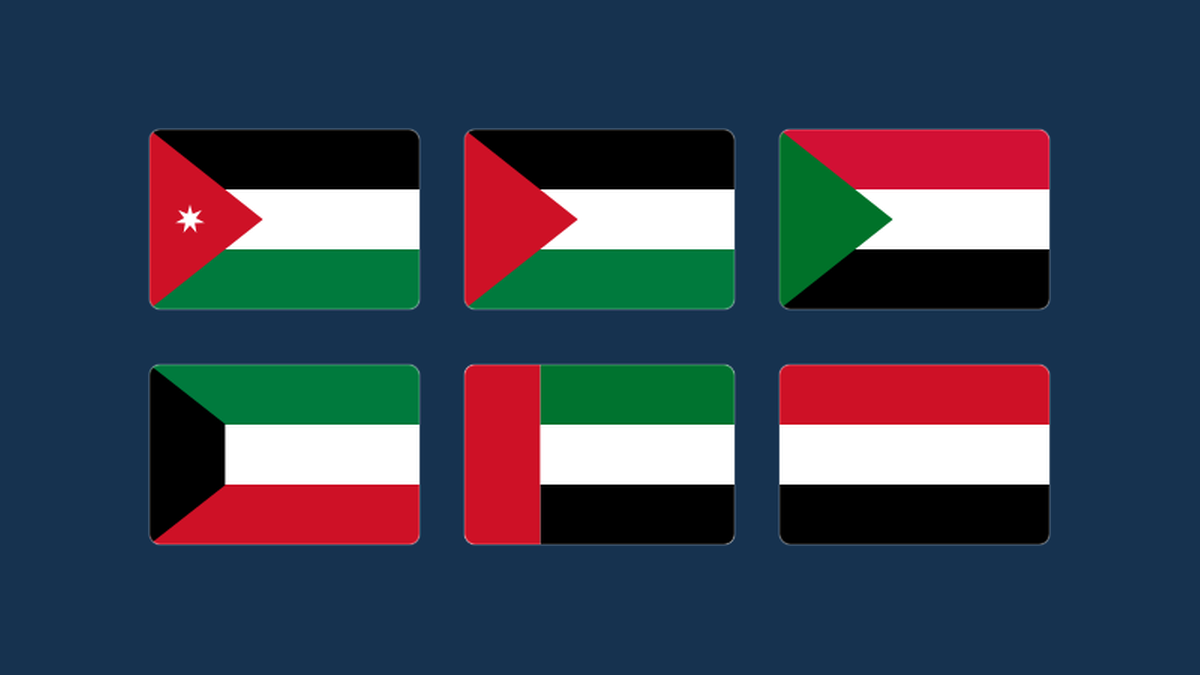
Black, white, green, red. Four colours that return from Jordan to Yemen, and whose story begins with an uprising in the Arabian desert.
From Jordan to Iraq, from Kuwait to Palestine, the same palette returns on the flags of the Arab world: black, white, green and red. These four colours make up the Pan-Arab family. Their story does not begin in a designers' studio, but in the din of a war.
The year is 1916, in the middle of the First World War. The Arab provinces of the Ottoman Empire rise against Istanbul. This is the Great Arab Revolt. To gather scattered tribes under a single banner, the rebels adopt a flag that sets black, white and green in three horizontal bands behind a red triangle at the hoist. The design is usually credited to a Briton, the diplomat and officer Sir Mark Sykes, though some accounts hand the final choice to Sharif Hussein himself. Whoever drew it borrowed the shape of a European tricolour, a deliberate break with Ottoman emblems, keeping the star and crescent off the cloth entirely.
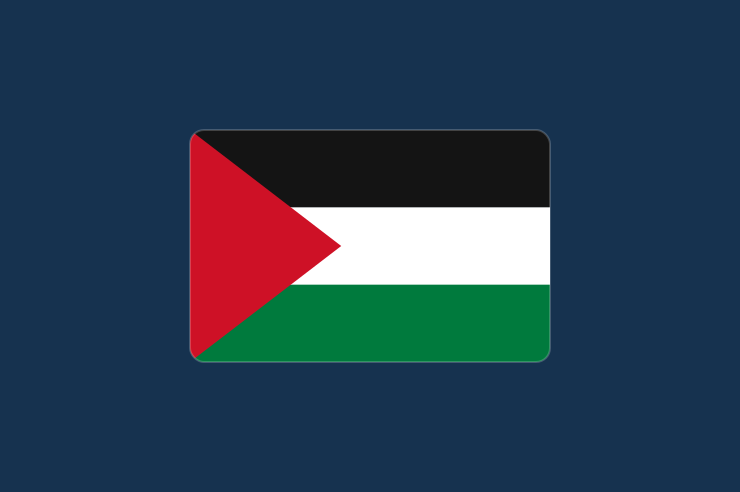
The colours themselves, though, are anything but European: each answers to Islamic tradition. That is exactly what let this "flag of the Arab Revolt" become the visual template for a whole generation of Arab states born in the 20th century.
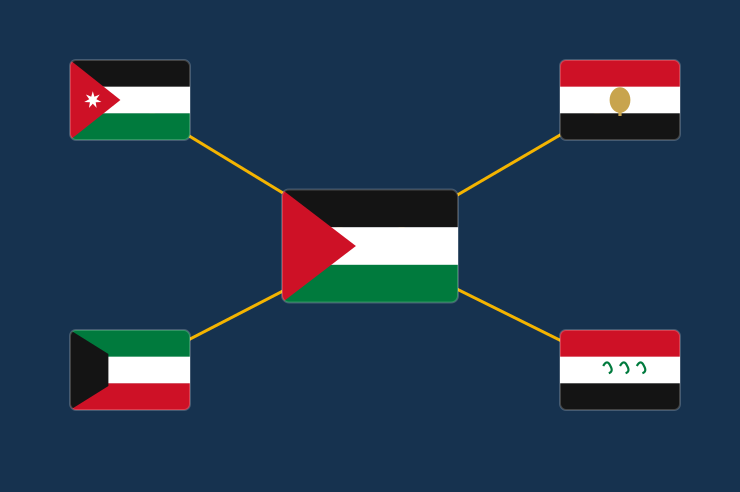
The uprising was led by Hussein ibn Ali, Sharif of Mecca and a leading figure of the Hashemite dynasty. His flag became that of the Kingdom of the Hejaz, a short-lived state in the west of present-day Arabia. From there, the four colours radiated outward. As the former Ottoman provinces and then the colonial mandates unravelled, new states appeared from the Levant to the Nile valley, and each drew on this palette to declare its belonging to a single community. The Hashemites themselves ruled for a time in the Hejaz, in Iraq and briefly in Syria, and still reign in Jordan today. A war flag had become a common language.
Why these four precise shades? The traditional reading ties each to a great era of Arab and Islamic history. Black recalls the banner of the Abbasid caliphate. White evokes that of the Umayyads. Green stands for Islam itself, and by some accounts for the Fatimids. Red, finally, is the colour of the Hashemites, the very dynasty that led the 1916 revolt.
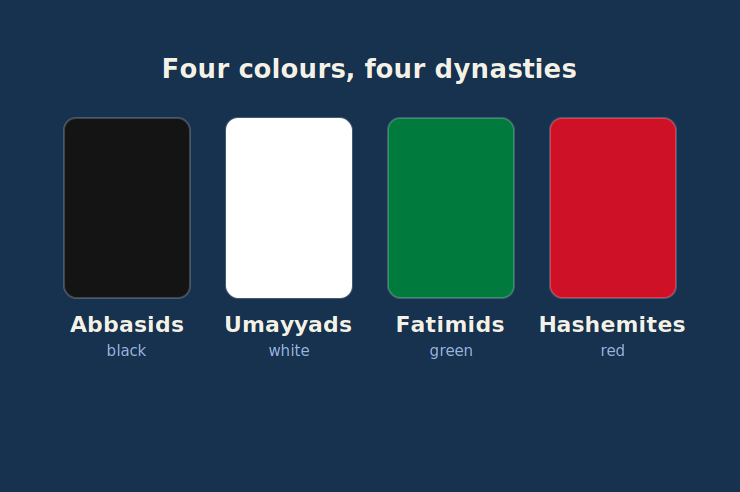
To sum up this symbolism, people often quote a line attributed to the 14th-century poet Safi al-Din al-Hilli, who celebrated white deeds, black battles, green meadows and red swords. The phrase is a fine one, and it reminds us that these colours carried centuries of memory long before they ever adorned a flag. “White are our blessings, black are our battles, green are our pastures, red are our swords” (بيض صنائعنا سود وقائعنا خضر مرابعنا حمر مواضينا).
The Pan-Arab family in fact splits into two main currents, easy to tell apart once you know them.
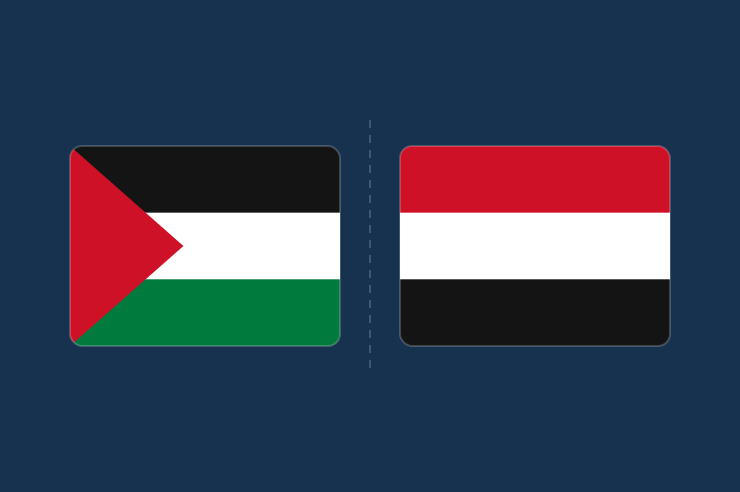
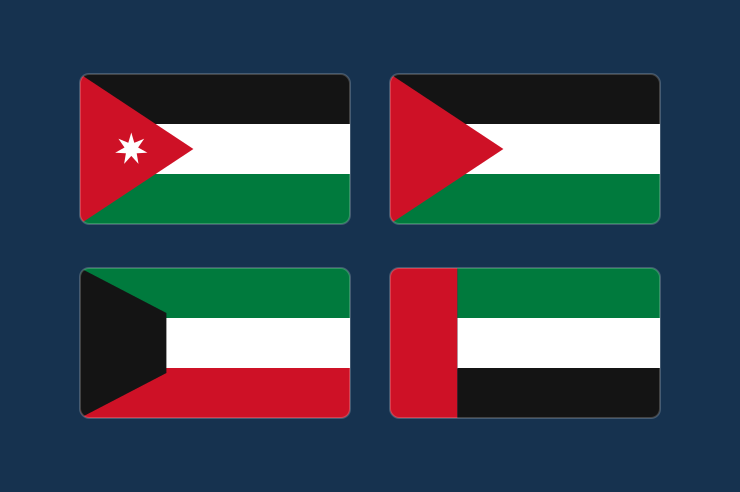
The first descends directly from the Arab Revolt and keeps all four colours, usually as horizontal bands with a coloured wedge at the hoist. You will recognise it in Jordan and Palestine, black-white-green behind a red triangle, and again in Kuwait, the United Arab Emirates and Western Sahara.
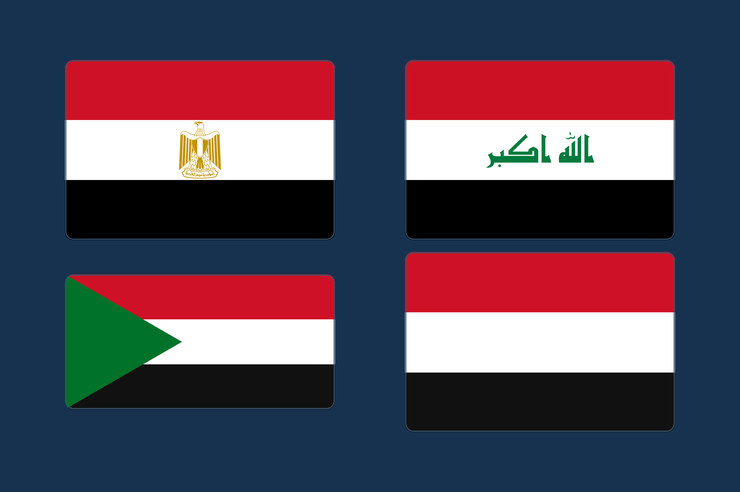
The second was born in Egypt after the revolution of 1952. Sometimes called the Arab Liberation flag, it favours red, white and black in three horizontal bands, with green pushed to the margin or dropped altogether. Egypt, Iraq, Sudan and Yemen belong to this line, often with a central emblem unique to each nation. Syria long belonged to it too, before returning, in 2025, to its green, white and black independence flag with three red stars.
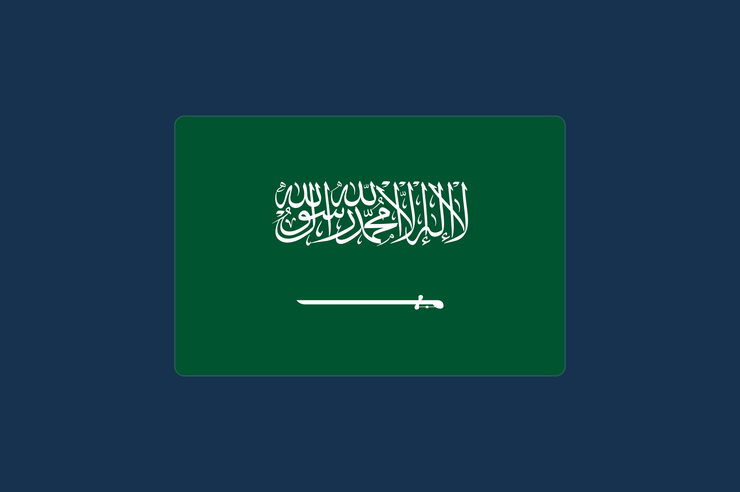
A clarification is in order. Not every flag in the Arab world belongs to this family. Saudi Arabia, for instance, flies a green flag bearing the Muslim declaration of faith above a sword, with no link to the 1916 revolt. Conversely, some countries add to the Pan-Arab base an emblem all their own, such as the takbir that runs across the Iraqi flag. The family is vast, but it has its borders.
Two currents, one ambition: to assert, through a simple play of four colours, an Arab identity shared across borders. That original revolt flag still flies at giant scale over the Gulf of Aqaba, in Jordan, from one of the tallest flagpoles in the world. Like the Nordic cross or the Pan-African colours, this arrangement tells, to whoever can read it, a whole shared history.
Dig deeper: https://en.wikipedia.org/wiki/Pan-Arab_colors
Keep exploring