Why Do So Many African Flags Share the Same Colours?
23 Aug 20265 min read
Almost every flag is a rectangle, but almost none share the same one. A flag's proportions are a real design choice, shaped by imitation, by law, and by the wish to stand apart. Here is how ratios work, and why they vary so much.
Most people never notice the single most basic decision behind any flag, which is its shape. Almost every national flag is a rectangle, yet almost none of them share the same proportions. Some are close to square, some are long and low, and a few sit at genuine extremes. This is the world of the aspect ratio, the relationship between a flag's height and its width, and it is settled before a single colour or star is chosen. Once you start to see it, you notice it everywhere.
A flag's aspect ratio is simply its height compared with its width, and it is usually written as height then width. A flag described as 2:3 is two units tall for every three units wide. A flag described as 1:2 is exactly twice as wide as it is tall. The ratio is easy to overlook, but it does real work. A tall, near square flag tends to feel solid and ceremonial, while a long, low flag looks built to stream out in the wind. The shape sets the tone before the eye has taken in anything else.
If you had to guess the proportions of a national flag chosen at random, the safe answer would be 2:3. It is by a wide margin the most common ratio on Earth, used by France, Italy, Argentina, Japan, Nigeria, and dozens of others. The next most common is 1:2, the longer and leaner rectangle favoured by the United Kingdom, Australia, and much of the Commonwealth. Two reasons explain why these proportions dominate. The first is imitation. Flags spread by copying, and new nations tended to model their banners on the powers they already knew, which carried the proportions along with the design. The second is simply that a 2:3 rectangle sits close to shapes the human eye finds comfortable, which matters because a flag has to read cleanly from a distance and look balanced on a pole.
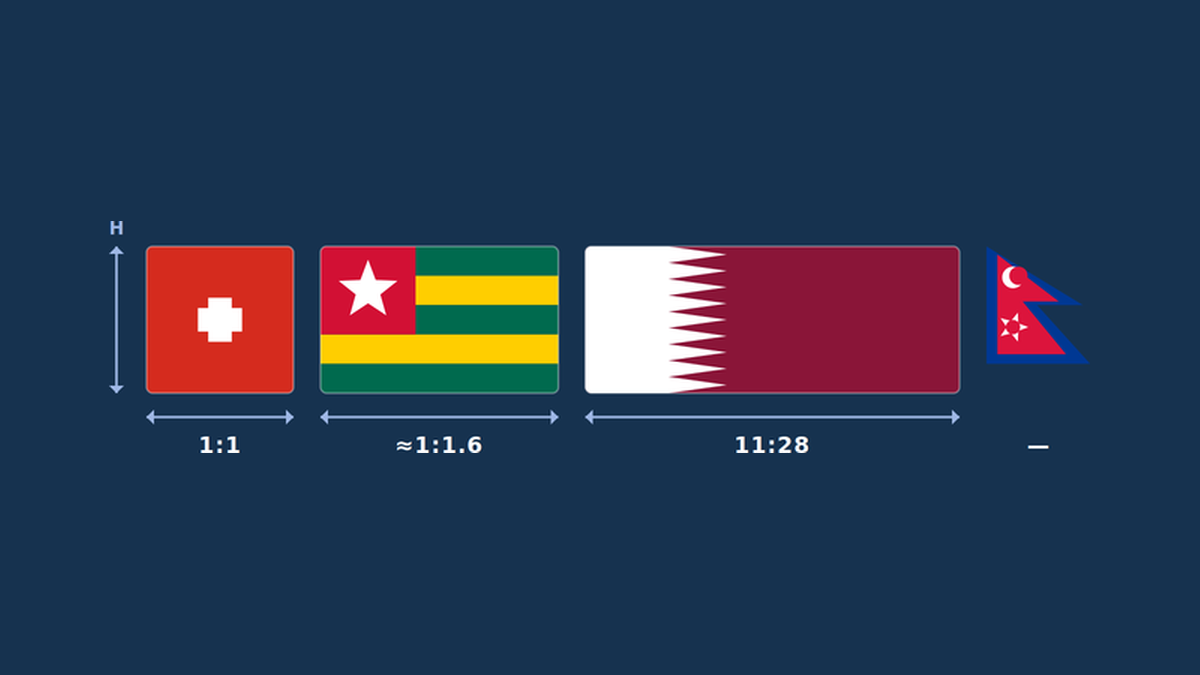
One flag has attracted a story that flag lovers repeat with great affection, and it deserves a careful look. The claim is that Togo, whose flag was designed by the artist Paul Ahyi, was shaped around the golden ratio, the proportion of roughly 1 to 1.618 that mathematicians write with the Greek letter phi and that artists have chased for centuries. It is a lovely idea, and it may even be true, but it is not settled. The Togolese constitution describes the flag's stripes, its star, and its colours in detail, and it says nothing at all about the proportions. As a result, the sources disagree. The vexillologist Whitney Smith recorded the ratio as roughly 3:5. Others give 2:3. The golden ratio is a third possibility, repeated widely but never actually confirmed. Depending on whom you ask, the flag of Togo is an ordinary 3:5 rectangle or a perfect golden one, and part of its charm is that nobody can prove the case either way.
Only two sovereign states fly a perfectly square flag, with a ratio of 1:1. One is Switzerland, whose square descends from medieval military banners and reads as neutral and compact. The other is Vatican City, whose 1:1 proportion was most recently confirmed in its 2023 Fundamental Law. A square flag is an unusual choice, and in both cases it does quiet work by refusing to look like anyone else's.
At the far end of the spectrum sits Qatar, with a ratio of 11:28. Its flag is more than two and a half times as wide as it is tall, which makes it the only national flag whose length is more than double its height. Placed beside any other flag, it looks stretched, almost like a banner that kept going. A different kind of extreme belongs to El Salvador, and it is worth being precise here, because El Salvador actually has three official flags. The version most people see, flown by citizens and at celebrations, is a straightforward 3:5. The grand ceremonial version, called the Bandera Magna, which carries the full national coat of arms and also serves as the war flag, is specified at the unusual ratio of 189:335. That oddly exact number exists because a law once wrote it down to the fraction and never let it go. Most Salvadorans fly the tidy 3:5, while the state keeps the strange one for its largest occasions.
The United States has its own quiet peculiarity, a ratio of 10:19 fixed for the official government flag, an uncommon proportion preserved as a mark of continuity.
Then there is Nepal, which sets aside the whole premise. It is the only national flag in the world that is not a rectangle. Two stacked triangular pennants form a five sided shape that is taller than it is wide. Its proportions are not given by a simple ratio at all. Instead they follow a geometric construction, set out step by step in Nepalese law, that produces an irrational number rather than a neat fraction. The two peaks recall the Himalayas, and the sun and the moon express a wish that the nation endure as long as they do.
Nepal creates a genuine problem for one specific group of people, the officials who arrange flags at international bodies. At the United Nations and the European Union, flags are flown at a uniform height in matching rectangles so that no country appears larger or smaller than another. Switzerland, the Vatican, and Nepal all break that grid, so each receives careful handling that preserves its true shape while adjusting the height so the whole row still looks even.
The shape of a flag is never only a matter of geometry. It reflects inheritance, in the sense of which flag a country chose to copy. It reflects law, in the sense of what a founding document happened to specify, sometimes down to the last fraction. And it reflects identity, in the sense of whether a nation wanted to look like everyone else or preferred to stand apart. Most countries settled on the familiar rectangle and moved on. A brave few chose to be different, and their proportions announce that choice before the viewer has registered a single colour, stripe, or star. The shape gets there first.
Keep exploring