Why Do So Many African Flags Share the Same Colours?
23 Aug 20265 min read
New Zealand spent 26 million dollars, ran two national votes, sifted through 10,292 public designs, and ended up keeping the flag it already had. Changing a flag turns out to be one of the hardest things a country can attempt.
In 2014, Prime Minister John Key told New Zealanders they would get to vote on their flag. The Union Jack in the corner, he argued, no longer described the country. A silver fern might.
What followed was the most thorough flag consultation ever attempted by a democracy. A Flag Consideration Panel was appointed. The public submitted 10,292 designs. Those were cut to a longlist of forty, then a shortlist of four, then five after a petition forced the Red Peak design back into contention.
The first referendum ran from 20 November to 11 December 2015, using preferential voting to rank the alternatives. Turnout reached 48.78%, and nearly one ballot in ten came back informal, many of them deliberately spoiled by people who objected to the exercise itself. Kyle Lockwood's black, white and blue silver fern won.
The second referendum, held from 3 to 24 March 2016, put that design head to head with the existing flag. Turnout jumped to 67.78%. The existing flag won with 56.6% against 43.2%.
Total cost: around 26 million New Zealand dollars. Total change: none.
That outcome is not unusual. It is closer to the norm. Flags are among the hardest national symbols to replace, and the reasons why say a lot about what a flag actually is.
Strip away the local detail and almost every flag change follows one of four routes.
A commission designs it. A body is appointed, it gathers submissions, it narrows them down, and a legislature adopts the result. This is the slowest route on paper and the most reliable in practice.
Voters decide it. A referendum puts one or more designs to the public. This is the most democratic route and by some distance the most likely to fail.
A government decrees it. A law or executive act changes the flag with no public vote. Quick, and dependent entirely on the legitimacy of whoever signs.
The state itself changes. Independence, revolution, partition or regime collapse. The flag changes because the thing it represented no longer exists. This is the fastest route of all, and nobody plans it.
Mississippi had flown a flag containing the Confederate battle emblem since 1894. Attempts to remove it had failed for decades, including a 2001 referendum in which voters chose to keep it by a wide margin.
In June 2020, amid nationwide protests, the state legislature did something the referendum route had never achieved: it retired the flag outright, before any replacement existed. A Commission to Redesign the Mississippi State Flag was appointed, nine members, three named by the Governor, three by the Lieutenant Governor and three by the Speaker of the House. It was chaired by Reuben V. Anderson, a former state Supreme Court justice.
The commission produced a single design, a magnolia surrounded by stars with the words "In God We Trust". It went to voters on 3 November 2020 as a straight yes or no, with no option to restore the old flag. It passed with 72.98% in favour.
The sequencing is what made it work. Voters were asked whether they accepted a new flag, not whether they wanted to lose the old one. Those are different questions, and they produce different answers.
Maine offers the cleanest counter-example, because the proposed design was genuinely good.
The state has flown its coat of arms on a blue field since 1909, a farmer and a sailor flanking a shield, the kind of design vexillologists file under "seal on a bedsheet". Before that, from 1901 to 1909, Maine had flown a green pine tree and a blue North Star on a buff background. Simple, distinctive, drawable from memory. It satisfies every principle in Ted Kaye's "Good" Flag, "Bad" Flag.
Question 5 went to voters on 5 November 2024. It was rejected, roughly 56% to 44%.
The map of that vote is the interesting part. Portland backed the new flag with 68% in favour. Coastal towns such as Cape Elizabeth and Camden came in at 66%. Inland and northern communities went the other way, several of them at 78% against.
The design was not really what was on the ballot. Familiarity was.
The fastest way to change a flag is to change the state.
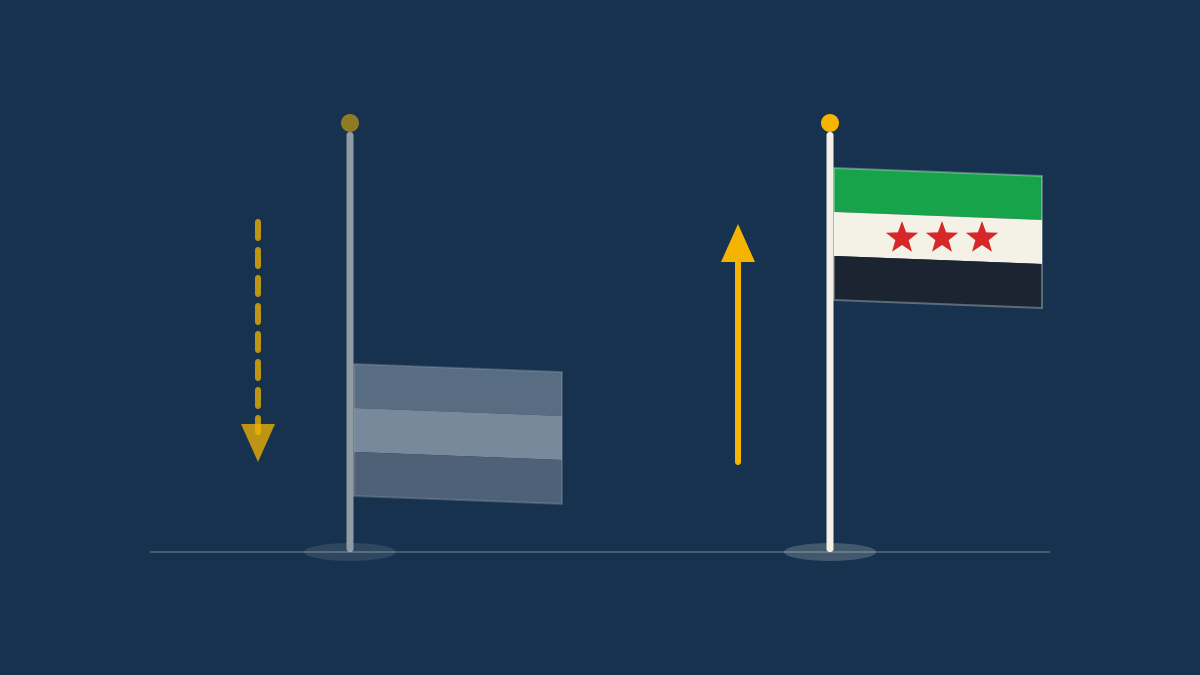
On 8 December 2024, the Assad government fell. The flag that appeared across Damascus was not new. It was the independence flag used from 1932 to 1958, a green, white and black tricolour with three red stars along the centre stripe, stars that historically stood for Aleppo, Damascus and Deir ez-Zor. It had been the opposition's banner throughout the civil war, and illegal to fly in much of the country.
It became the de facto national flag immediately, was written into the Constitutional Declaration of 13 March 2025, and was raised at United Nations headquarters by the foreign minister on 25 April 2025.
No commission, no referendum, no shortlist. The design had been chosen years earlier by the people who carried it.
This is worth noticing, because it inverts the usual assumption. We tend to imagine flags being handed down by governments. In the cases where change happens fastest, the flag comes from below and the government catches up.
Put the cases side by side and a pattern appears.
Where a flag is already contested, change succeeds. Mississippi's flag had been a live political argument for a generation, and the vote passed by nearly three to one. Syria's flag was the symbol of one side of a war.
Where a flag is merely dated, change fails. New Zealand's flag offended nobody in particular. Neither did Maine's. The reformers in both cases were arguing about design quality, and design quality turns out to be a weak motivator when weighed against something people already recognise.
There is also an asymmetry in what is being asked. A new flag offers an abstract future benefit. The current flag carries accumulated memory: coffins, medal ceremonies, sports finals, family photographs. One is an argument, the other is an attachment, and attachments generally win.
And the ballot design matters enormously. Mississippi asked "do you accept this?" with no way back. New Zealand asked "which of these two?" and gave people a way to say no twice. Maine asked voters to give up something familiar for something better. Only the first framing succeeded.
If you want a flag changed, the evidence points one way. Referendums feel like the legitimate route and are the least likely to deliver. Commissions do the real work, and legislatures do the deciding.
Minnesota is the current illustration. Rather than putting the question to voters, the state created a State Emblems Redesign Commission in 2023, took advice from vexillologists including Ted Kaye, and adopted a simplified design in 2024. Utah went through a comparable process in the same period.
Neither state asked its voters directly. Both now have new flags.
That is not an argument for or against public consultation. It is an observation about what flags are. A flag is not chosen the way a logo is chosen, by picking the strongest option. It is inherited, and inheritances are surrendered reluctantly, whatever the design merits of the replacement.
New Zealand spent 26 million dollars establishing that its citizens preferred the flag they already had. Expensive, but not wasted. The country now knows something it only assumed before.
Keep exploring