Why Do So Many African Flags Share the Same Colours?
23 Aug 20265 min read
Imagine traveling halfway across the world to represent your country at the Olympic Games, only to discover that another nation has shown up carrying... your flag.
The Day Two Countries Realized They Had the Same Flag
"Imagine traveling halfway across the world to represent your country at the Olympic Games, only to discover that another nation has shown up carrying... your flag."
It sounds like the opening scene of a comedy movie.
Except it really happened.
In the summer of 1936, during the Berlin Olympic Games, two countries—separated by more than 7,000 kilometers, with completely different cultures, histories, languages and political systems—made an astonishing discovery.
They had the exact same national flag.
The countries were Haiti and Liechtenstein.
And what happened next permanently changed one of their flags forever.
Flags are surprisingly simple things.
A few colored pieces of fabric stitched together.
Yet throughout history, they have carried enormous meaning. They fly over castles, government buildings, embassies, ships and battlefields. They represent entire nations in seconds, often without a single word needing to be spoken.
A flag has one primary purpose:
Be instantly recognizable.
That's why many countries spend decades debating the exact shade of blue, the proportions of stripes, or the position of a single star.
The challenge is that there are only so many ways to arrange a rectangle.
A handful of colors.
A few geometric patterns.
Some stripes.
Maybe a cross.
Perhaps a star or coat of arms.
With nearly 200 sovereign states today—and thousands of historical kingdoms, republics and principalities before them—similarities are almost inevitable.
Today we can compare every flag on Earth in seconds.
But imagine designing a national flag in the 1800s.
There was no internet.
No searchable database.
No Wikipedia page listing every country's flag.
Many governments had little contact with distant nations. International travel was slow, expensive and rare. Some countries barely interacted with one another at all.
If you were a small European principality or a Caribbean republic, how could you possibly know whether another country had already chosen the exact same design?
For decades, Haiti and Liechtenstein didn't.
Neither had any reason to suspect there was a problem.
Until the Olympics.
These were no ordinary Olympic Games.
By the summer of 1936, Adolf Hitler had been in power for more than three years, and the Berlin Olympics had become far more than a sporting event. They were designed to showcase Nazi Germany to the world. Some countries, particularly the United States, even debated boycotting the Games, arguing that participating would legitimize Hitler's regime. In the end, they attended, and athletes like Jesse Owens would go on to make history by winning four gold medals in front of the Nazi leadership.
But while history remembers Berlin 1936 for politics, propaganda and sporting legends, another story was quietly unfolding.
One with no medals.
No records.
Just two flags.
Berlin had become the center of the sporting world.
Athletes from dozens of countries arrived carrying their national flags for the Opening Ceremony.
For Liechtenstein, it was a particularly significant moment.
The tiny Alpine principality was participating in the Summer Olympics for the very first time.
Everything had to be perfect.
Their flag?
Two simple horizontal stripes.
Blue on top.
Red on the bottom.
Elegant.
Minimal.
Distinct—or so everyone believed.
Meanwhile, Haiti had arrived carrying...
Two horizontal stripes.
Blue on top.
Red on the bottom.
Exactly the same.
Not almost.
Not similar.
The same.
According to Olympic records and later historical accounts, the delegations discovered the coincidence before the Opening Ceremony.
Imagine that conversation.
"Excuse me..."
"I think you're carrying our flag."
"No... that's our flag."
"No, we're pretty sure it's ours."
Someone checks.
Someone checks again.
Everyone realizes that both countries are right.
Two sovereign nations.
One flag.
Fortunately, neither delegation wanted confusion during the parade of nations.
So they improvised.
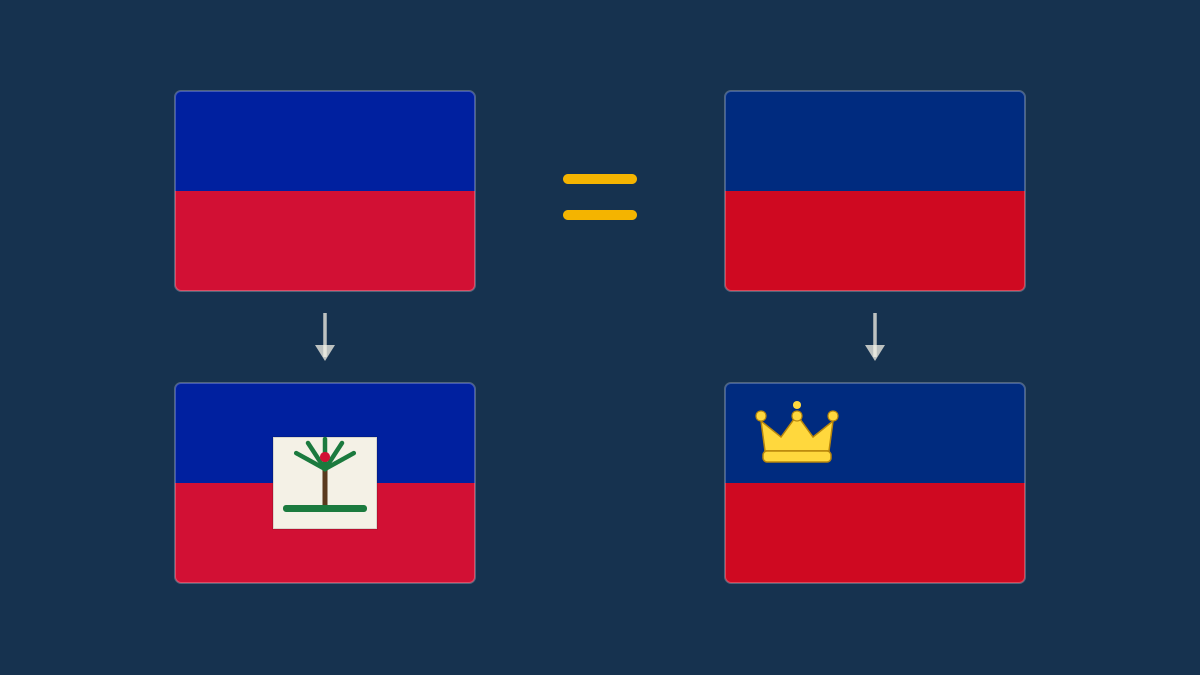
Haiti switched to its state flag, which featured the country's coat of arms in the center.
Liechtenstein obtained approval to modify its own flag by adding a golden princely crown in the upper corner.
Just enough to distinguish the two.
The solution worked.
Spectators could now tell them apart.
But the incident had exposed a much larger problem.
Liechtenstein's official national flag was not unique.
After returning home, Liechtenstein decided this wasn't simply an Olympic inconvenience.
It was a national identity issue.
In 1937, the principality officially adopted a new version of its flag.
The familiar blue-over-red design remained.
But now a golden princely crown appeared in the upper left corner.
The crown wasn't added simply for decoration.
It served two purposes.
First, it reflected Liechtenstein's status as a principality ruled by a prince.
Second—and perhaps more importantly—it ensured that the country's flag could never again be mistaken for Haiti's.
Nearly ninety years later, that same crown is still there.
Every time you see the flag of Liechtenstein today, you're looking at a reminder of an unexpected discovery made during the 1936 Olympics.
This is where many retellings of the story simplify things a little too much.
You'll often read that both countries changed their flags.
That's not quite accurate.
Haiti had long used two versions of its flag.
Its civil flag was simply blue over red.
Its state flag included the national coat of arms in the center.
At the Berlin Olympics, Haiti used the state version for the Opening Ceremony to avoid confusion.
The coat of arms itself wasn't invented because of the Olympic incident—it had existed for generations.
So while Liechtenstein permanently redesigned its national flag after Berlin, Haiti simply used a different official version that already existed.
It's a small historical detail, but an important one.
Probably not.
At least, not in the same way.
Today, governments have instant access to information.
Design committees can compare their proposed flags against every national flag on Earth in minutes.
International organizations maintain official records.
Flag enthusiasts—known as vexillologists—document even the smallest historical variations.
Ironically, globalization has made national flags more unique than ever.
Yet coincidences still happen.
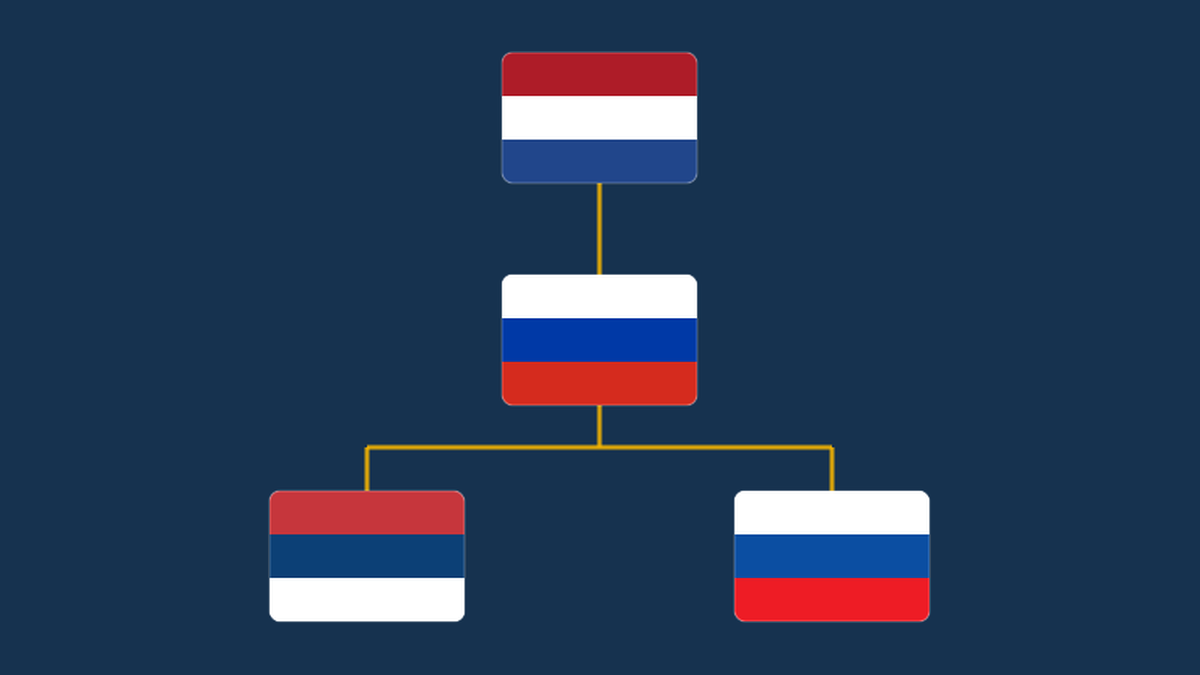
Romania and Chad have nearly identical tricolors.
Indonesia and Monaco share virtually the same red-over-white design, differing mainly in proportions.
Poland and Monaco are mirror images if you rotate one.
The difference is that today everyone knows about these similarities from the beginning.
Back in 1936, the Olympics became the world's first "real-life flag comparison."
The incident lasted only a short time.
No diplomatic crisis followed.
No angry disputes erupted.
Instead, two delegations solved the problem with remarkable pragmatism.
One temporary modification became permanent.
And a small golden crown quietly entered flag history.
It's one of those delightful historical stories that reminds us how interconnected the world has become.
Today, it seems impossible that two countries could unknowingly share the same flag for years.
But in an era before instant communication, before global databases and before the internet, it wasn't just possible.
It happened.
And it took the biggest sporting event on Earth for anyone to notice.
So the next time you see the flag of Liechtenstein, look closely at the golden crown.
It's not just a symbol of monarchy.
It's the souvenir of one of the most charming cases of mistaken identity in Olympic history.
Keep exploring